
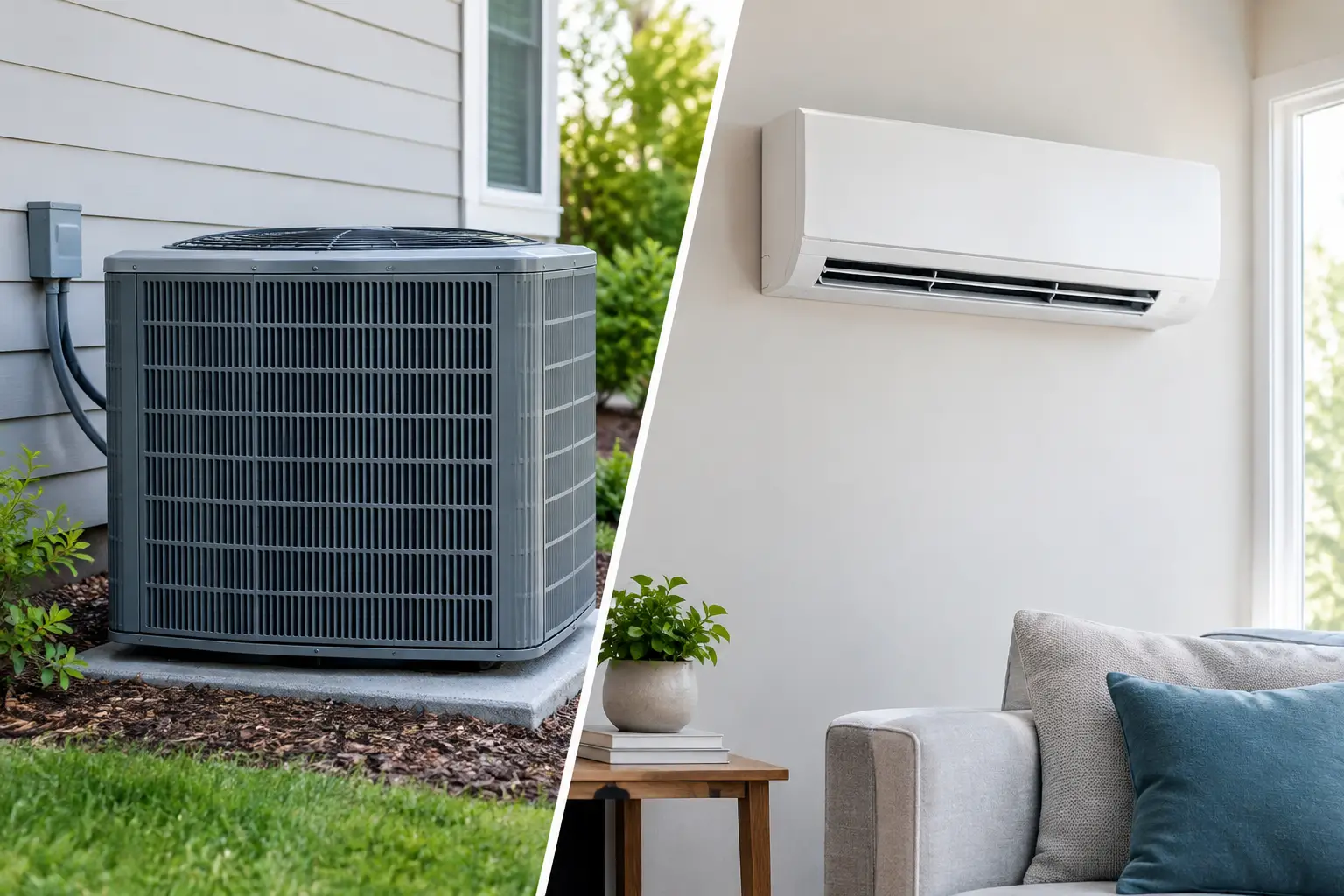
A hot Kentucky afternoon will expose a weak cooling system fast. Maybe the upstairs bedrooms stay sticky while the living room feels fine, or maybe an aging AC has quit and you need a replacement without turning the decision into a second full-time job. When comparing central air vs mini split, the best choice comes down to your home’s ductwork, layout, comfort priorities, and budget – not just the equipment price.
Both systems can keep your family cool and comfortable. The difference is how they deliver that comfort. Central air cools the whole home through a network of ducts. A ductless mini-split system sends conditioned air directly into individual rooms or zones. Each approach has real advantages, and each can be the wrong fit in the wrong house.
How Central Air and Mini-Splits Work
Central air conditioning uses one outdoor condenser connected to an indoor evaporator coil, usually located near your furnace or air handler. A blower moves cooled air through supply ducts and back through return ducts. One thermostat often controls the entire house, although zoning options are available for some systems.
A mini-split also has an outdoor unit, but it connects to one or more compact indoor air handlers through small refrigerant lines. Those indoor units are commonly mounted high on a wall, though ceiling, floor-mounted, and concealed options are available. Each indoor unit has its own temperature control, so rooms can be cooled independently.
Many mini-splits are heat pumps, which means they can provide both cooling in summer and efficient heating during much of our Central Kentucky winter. Central systems can also be paired with heat pump equipment, so heating capability is not exclusive to ductless systems.
Central Air vs Mini Split: Comfort Around the House
Central air is often the natural choice for a home that already has ductwork in good condition. It delivers an even, familiar whole-home feel without placing an air handler on the wall in every room. For families who want one system to serve bedrooms, living areas, hallways, and kitchens, central air keeps the equipment mostly out of sight.
The catch is that a single thermostat cannot always solve uneven temperatures. A two-story home may run warmer upstairs. A room over the garage, a sunroom, or a recently finished basement can have very different cooling needs from the rest of the house. Duct leaks, undersized returns, poor insulation, and airflow restrictions can add to the problem.
Mini-splits shine when room-by-room control matters. You can cool the primary bedroom at night without blasting the empty living room. You can give a home office, nursery, workshop, garage conversion, or bonus room its own dependable comfort. That zoning can make a major difference for households where family members prefer different temperatures.
Still, more zones do not automatically mean a better system. An open-concept home may be served well by fewer indoor units, while a home with many closed bedrooms may need several. A professional load calculation and room-by-room plan matters. Oversized or poorly located equipment can short-cycle, feel drafty, and fail to control humidity as well as it should.
Installation Can Change the Entire Decision
If your home already has usable ducts, replacing central air is usually the more straightforward path. The existing duct system still needs an inspection. Leaky, dirty, crushed, or poorly designed ducts can waste energy and leave rooms uncomfortable no matter how efficient the new outdoor unit is.
If your home has no ducts, adding central air can become a larger project. Running ductwork through an older home, addition, finished attic, or slab foundation may require space, construction work, and extra expense. A ductless mini-split avoids that disruption because it needs only small wall openings to connect the indoor and outdoor equipment.
This is why mini-splits are especially useful for additions and hard-to-condition spaces. Instead of extending an already strained central system into a new room, a dedicated mini-split can provide the capacity that space actually needs. It can also be a smart solution when a single room is consistently too hot or too cold.
Appearance deserves an honest conversation, too. Central air has the advantage of hidden delivery through registers. Mini-split heads are visible, although modern options are much less intrusive than many homeowners expect. If the look of a wall-mounted unit would bother you every day, that matters. Comfort should fit your home and how you use it.
Energy Efficiency and Monthly Costs
Ductless mini-splits are known for high efficiency, partly because they avoid energy loss from ductwork. They also use inverter-driven technology that can adjust output rather than cycling at full power all the time. In a space that needs steady, moderate cooling, that can reduce energy use while maintaining a more consistent temperature.
Central air can be highly efficient as well, especially when paired with properly sealed and insulated ducts. A new system with the right capacity, good airflow, and regular maintenance can be a substantial improvement over an older unit that struggles through every summer heat wave.
The monthly savings question is less simple than it sounds. Mini-splits can save energy when you condition only the occupied areas of the home. But if every indoor unit runs all day across a large house, the savings may be smaller than expected. Central air may be more practical for whole-home cooling when the duct system is sound and the home is occupied throughout the day.
Humidity is another part of comfort in Kentuckiana. A system should remove enough moisture to keep the house from feeling clammy, not merely lower the thermostat reading. Proper sizing, installation, airflow, and maintenance all affect humidity control. Bigger is not better. An oversized system may cool too quickly, shut off early, and leave moisture behind.
Upfront Cost, Maintenance, and Long-Term Value
Central air replacement can be more affordable upfront when a home already has good ducts and a compatible furnace or air handler. If duct repairs or major modifications are needed, that equation can change. The equipment is only one part of the installation. Electrical needs, refrigerant lines, drainage, controls, and duct condition all belong in the estimate.
A single-zone mini-split is often a cost-effective answer for one problem room. A multi-zone mini-split serving an entire home can be a larger investment, particularly when several indoor heads are required. It may still be the better value when it eliminates the need to install a complete duct system or gives the household comfort control central air cannot easily match.
Both options need upkeep. Central air benefits from clean filters, clear outdoor equipment, annual maintenance, and duct inspections when airflow or indoor air quality concerns arise. Mini-splits need filter cleaning, coil care, proper condensate drainage, and professional service to keep every indoor head operating efficiently.
There is no good shortcut here: correct installation protects your investment. Refrigerant charge, airflow, electrical work, drain routing, and equipment sizing all affect reliability, efficiency, and system life. A low initial quote can become expensive if the work leaves your family with uneven comfort or repeat repairs.
When Each System Usually Makes Sense
Central air is often the better fit when you have a ducted home, want a clean whole-home appearance, and prefer one primary system serving every room. It also makes sense when your current ductwork can be repaired or improved without major reconstruction.
A mini-split is often the better fit for a room addition, older home without ducts, garage conversion, basement, attic space, or stubborn hot-and-cold area. It is also a strong option for homeowners who want independent temperature control and efficient heating and cooling from the same equipment.
Some homes benefit from both. A central system can handle the main living areas while a mini-split takes care of a bonus room or addition. This hybrid approach can prevent overloading the main system and improve comfort where it is needed most.
Start With Your Home, Not the Equipment
Before choosing between central air and a mini-split, look at the full comfort picture: the age and condition of your current system, duct performance, room temperatures, insulation, humidity, household routines, and future plans for the home. A technician should measure the space and evaluate the system instead of recommending equipment based on square footage alone.
For homeowners across Central Kentucky and Kentuckiana, Instant Aire can help sort out the practical details and recommend a system sized for your family’s real needs. Whether the answer is a whole-home central replacement, a ductless solution for one difficult room, or a combination of both, the right setup should make your home feel reliably comfortable when the weather refuses to cooperate.